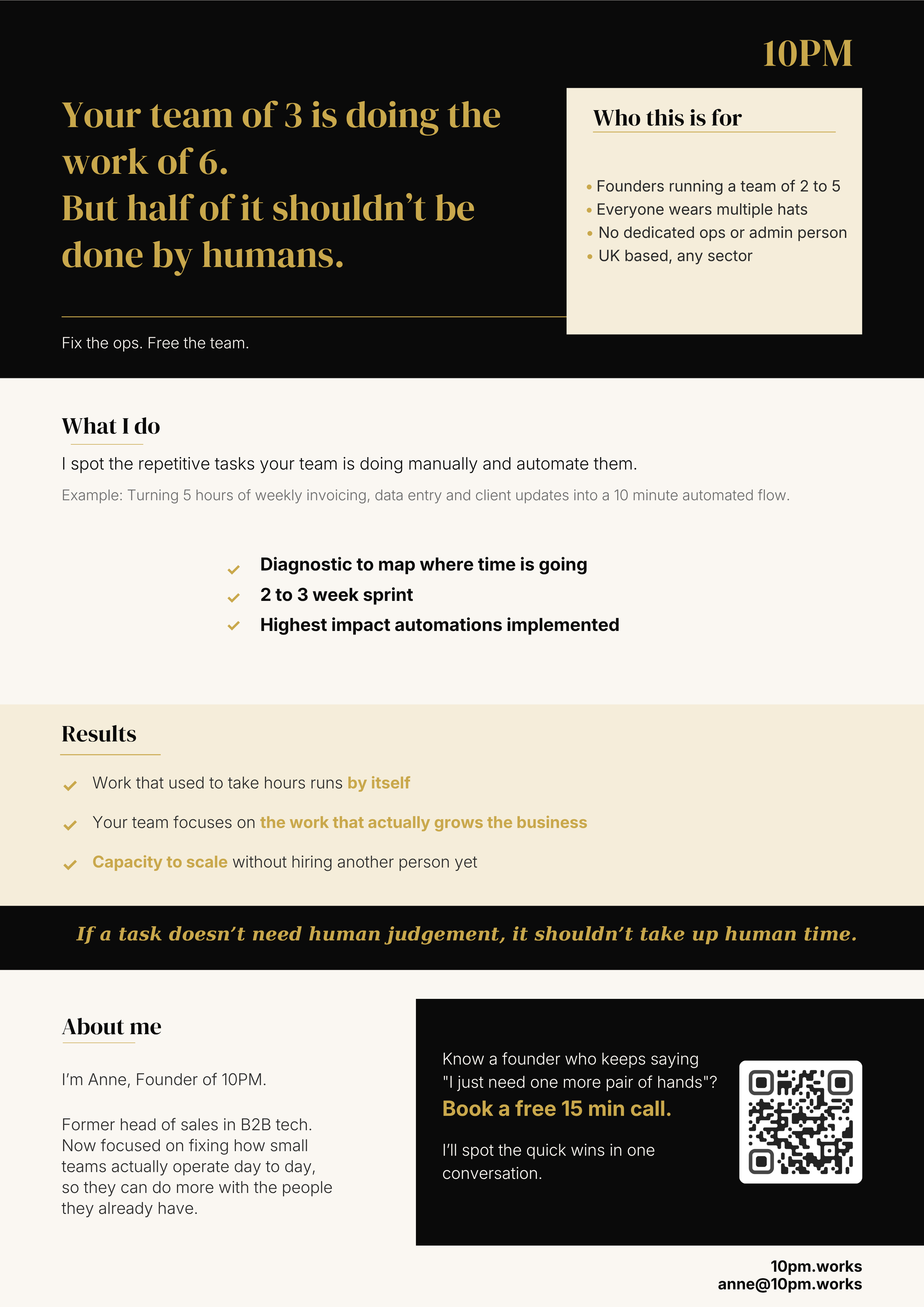
Your team of 3 is doing the work of 6. But half of it shouldn’t be done by humans.
For founders running a team of 2 to 5 with no dedicated ops or admin person. Here is what 10PM does.
What about software and cost?
I work with the tools your team already uses rather than replacing them. What automation does need is a connector platform to run the workflows (Make or Zapier, for example), and any AI steps run on a subscription such as Claude or ChatGPT. These are modest monthly costs, you own the accounts, and I set out exactly what is needed and what it costs in the Audit, so nothing is a surprise later.
Ready to create capacity without hiring?
15 minutes. Tell me how your team spends its week and I will tell you whether automation can create the capacity you need, or whether hiring is the better answer.
Book a 15 min review Download the PDFWorkflow automation for small teams · UK
Create capacity without hiring: what small teams automate
founder led teams of 2 to 5 hit a familiar ceiling: too much work, not enough people. The instinct is to hire. But before adding headcount, it is worth asking which of that work should not be done by a human at all.
Workflow automation for small teams works best on the tasks that repeat with every client, every month: onboarding, invoicing, status updates, reporting, data entry between systems. These are not tasks that need your team's judgement. They need consistency and speed, which automation handles better than people do.
The 10PM Time Leak Audit identifies what is genuinely automatable in your operation, what the annual cost of the current situation is, and whether a Sprint makes financial sense before you commit to anything. See also: hire vs automate: how to decide.
What small teams typically automate first
The highest-impact automations for small teams tend to be the ones that touch every client, every cycle. Client onboarding: welcome sequences, contract sending, access setup, briefing collection. All triggered automatically when a project is confirmed. Monthly reporting: templates that pull from your project management tool and produce a draft with no manual work. Invoicing: generation, sending, and conditional follow-up sequences that run without anyone managing them.
For teams, the compounding effect matters more than for solo operators. If two team members each spend four hours per week on automatable tasks, that is 400 hours per year across the team. At a blended rate of £150 per hour, the cost is £60,000. The same automation that removes the problem for one person removes it for everyone simultaneously.
Fix process before hiring
The most efficient small teams are not the ones with the most headcount. They are the ones where every team member spends their time on work that requires their skill. A team of three that has automated its repetitive workflows can often do the output of a team of five without adding payroll, management overhead, or the complexity of a bigger operation.
Before deciding to hire, it is worth understanding what is actually driving the capacity problem. If the bottleneck is volume of bespoke work that genuinely requires human judgement, hire. If it is the weight of repetitive, predictable admin underneath the real work, automate first. The hire vs automate decision framework walks through exactly how to make that call.
Not sure if it applies to you? The free 15 min review answers that without any commitment. · What is invisible work?